
Bears 27, Eagles 7: Case Keenum's Night at Soldier Field
Game recap of Bears vs. Eagles in Week 3 of the 2026 NFL season: Case Keenum threw two touchdowns, Chicago's defense produced three turnovers, and the Bears won 27-7 in Monday Night Football.
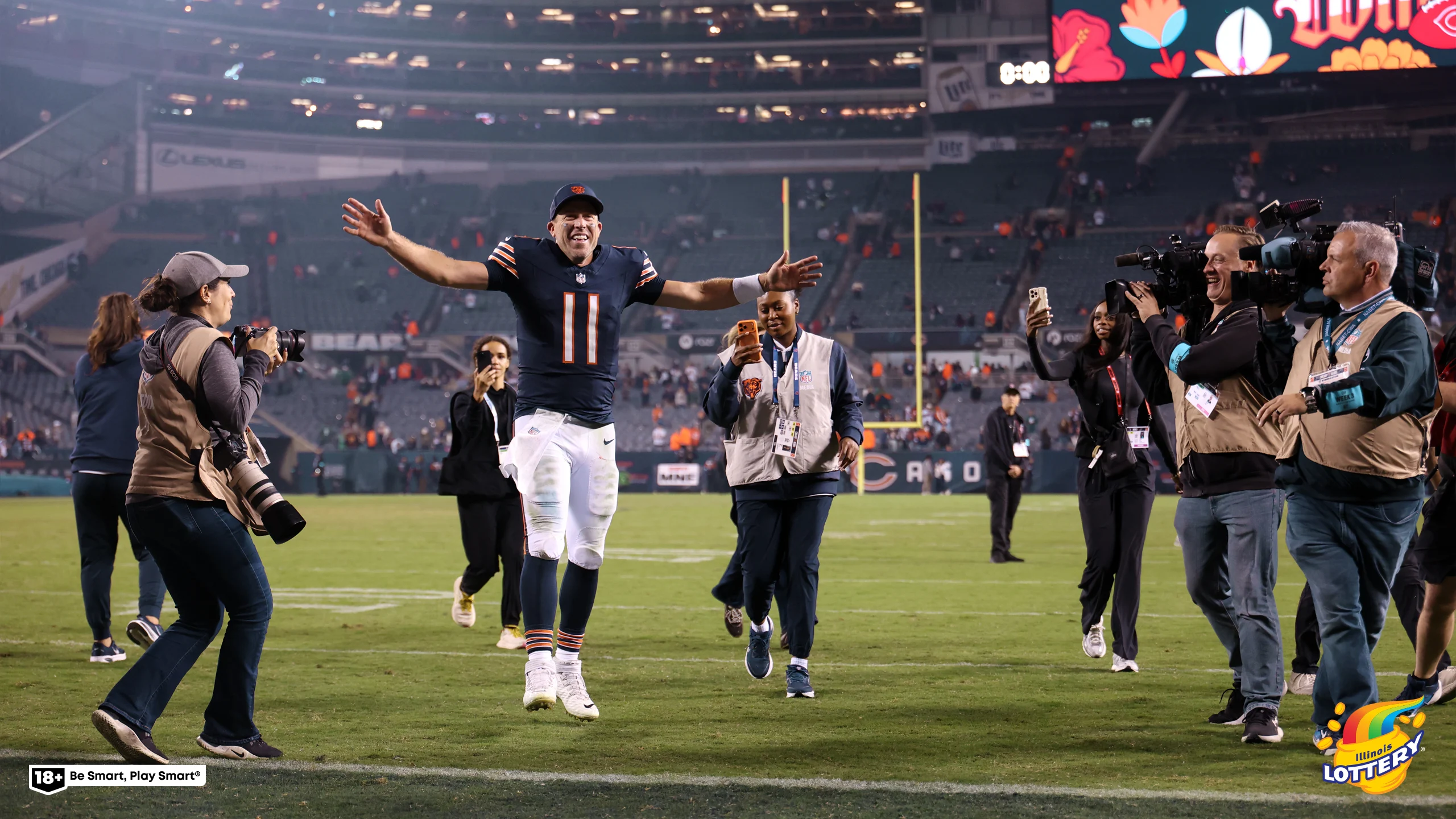
A week after failing to score touchdowns against Minnesota and losing Caleb Williams to a hamstring injury, the Chicago Bears returned to Soldier Field with their third quarterback and few certainties. They ended the night with a big win 27-7 over the Philadelphia Eagles, three handoffs forced and a performance that changed the mood of the city.
The star was Case Keenum, an 38-year-old veteran who hadn’t played a regular season game since 2023. But reducing the story to an individual surprise would miss the most important part: Chicago protected its star, Ben Johnson built a plan suited to his strengths, and the defense dominated the second half.
It wasn’t a flawless performance. The Bears wasted a possession from the 1-yard line, ran little during the first half, and received another alarm at the left tackle. Still, it was a better performance.
Keenum turned the emergency into an opportunity
Keenum started because Williams was out and Tyson Bagent hadn’t cleared the concussion protocol until Sunday, too late to fully participate in the offensive game plan. The decision seemed conservative: handing the ball to the quarterback with more experience and asking him to avoid mistakes against Vic Fangio’s defense.
The result exceeded that expectation. Keenum completed 24 of 34 passes for 247 yards, threw two touchdowns, didn’t fumble, and finished with a passer rating of 110.8. Additionally, he ran for a one-yard touchdown. It was his first game since December 2023 and his first start in almost three years.
His greatest virtue wasn’t his arm, but his rhythm. Keenum made quick decisions, distributed the ball among seven receivers, and wasn’t sacked. He completed 14 of 20 passes for 145 yards and two touchdowns on throws made in under 2.5 seconds. After the constant pressure Minnesota applied the week before, the difference was evident.
Ben Johnson also changed the script. Instead of asking Keenum to stretch plays, he designed clear reads, short passes, and opportunities for yardage after the catch. The quarterback kept the attack within the system and prevented Philadelphia from turning the game into a pursuit.
“This is about Case Keenum and what he was able to do tonight. He played an efficient game and couldn’t be prouder of him.”
— Ben Johnson, in post-game statements; translation from English.
Burden opened the door; Raymond broke the game
Chicago set the tone from the first possession with an 11-play, 66-yard drive. Keenum completed five of his first six passes and ended the drive with an eight-yard sideline pass to Luther Burden III. The rookie caught near the 5-yard line, absorbed the contact, and crossed the goal line with the help of his teammates.
Burden finished with seven receptions for 61 yards and a touchdown. His performance confirmed he can be more than a complementary piece: he was a reliable target for a quarterback needing immediate answers.
The decisive play came in the third quarter. Kalif Raymond found the middle of the field completely open, caught the pass in motion, and outran the last defender for a 41-yard touchdown. His six receptions for 90 yards led the team.
The play reflected Johnson’s night: formation, movement, and routes designed to create a simple decision. Keenum didn’t need to invent; he just needed to recognize the space and deliver the ball on time.
Chicago closed the game with a 13-play, 52-yard drive that consumed more than seven minutes. Keenum forced a false start by Moro Ojomo on fourth and two, and then scored on a one-yard run. At 38 years and 223 days, he became the oldest player in Bears history to score a rushing touchdown.
The offensive line responded, but the doubt reappeared on the left side
After the poor performance against Minnesota, the line had a clear obligation: give Keenum a manageable game. They did. Philadelphia didn’t record any sacks, and the veteran was able to operate with a much more stable clock.
The improvement doesn’t mean all doubts have disappeared. The rushing attack produced only 27 yards in the first half, before adding 101 after halftime. D’Andre Swift finished with 84 yards on 20 carries; the production came when the defense already had to respect the pass and started to lose possessions.
The main concern was Braxton Jones, who left the game in the third quarter with a right knee injury and didn’t return. Theo Benedet took his place. Until the Bears release the results of the tests, it’s not responsible to speculate on the severity or the time he might miss. The situation once again puts the position under scrutiny that Chicago still hasn’t stabilized.
Three turnovers and a suffocating second half
The defense of Dennis Allen had shown contradictory signals for two weeks. They allowed 37 points in Carolina, although producing key plays; then held Minnesota to nine points, but did so under extreme weather conditions. Facing Philadelphia, they delivered a more convincing performance.
The Eagles managed only 62 total yards in the second half, with three consecutive three-play, punt drives to start the third quarter. Chicago limited Jalen Hurts to 153 passing yards, a 64.2 rating, and an interception. Philadelphia converted only two of nine third-down opportunities.
The first turnover came from Austin Booker, who stripped the ball from Tank Bigsby after a short reception. Xavier Woods recovered the ball at the 15-yard line of Philadelphia. The Bears didn’t capitalize on the field position: a catch by Colston Loveland was marked at the 1-yard line, and the offense turned the ball over on fourth down. It was one of the few moments where there was a lack of decisiveness.
The second turnover prevented a scoring drive. Hurts temporarily left the game to be evaluated for a possible concussion after taking a hit from D’Marco Jackson. With Philadelphia facing the end zone, the backup Andy Dalton launched directly toward Dillon Thieneman, who recorded his first career interception.
The third turnover came at the end of the third quarter. On fourth down, Hurts locked his gaze too early on DeVonta Smith and T.J. Edwards stepped in the path. Edwards also deflected three passes during the game.
Saquon ran in the first half; Chicago closed the door after
Saquon Barkley produced 73 yards on 11 carries before halftime and threatened to control the game. In the second half, he managed only nine. That adjustment was one of the major merits of the defense: the Bears improved their assignments, closed the interior spaces, and forced Hurts to win from the pocket.
Philadelphia scored only with its known short rushing game at the end of the first half. Outside of that drive, they never found continuity. The Bears won the turnover battle 3-0, and the offense converted the defensive dominance into 17 points without a response after halftime.
It’s important to keep perspective. The Eagles had already shown inconsistencies in their first two wins and committed ten penalties for 61 yards. Chicago capitalized on those mistakes; they don’t need to apologize for it. Good teams turn the opponent’s mistakes into control of the game.
Philadelphia found no excuses
Coach Nick Sirianni described the result as a collective loss and took responsibility. Philadelphia was outmatched in rushing, ball protection, and adjustments. Hurts returned after his medical evaluation, but never established rhythm and acknowledged the team needed to learn from the experience.
On Chicago’s side, the difference was the coordination between the three units. The defense forced turnovers, the offense didn’t turn the ball over, and the special teams added two field goals by Cairo Santos. For the first time this season, the Bears didn’t need one part of the team to compensate for the problems of another.
The columnist’s note
The victory doesn’t open a controversy in the quarterback position. Caleb Williams remains the present and future of the franchise. What Keenum did offers something different and valuable: it shows Chicago can compete while its starter recovers and that Johnson knows how to adapt his offense to the available quarterback. This is the first time Johnson has had to plan and play with a backup quarterback throughout his entire career as an offensive coordinator or head coach.
It also leaves a lesson for when Caleb returns. The ball came out fast, the protection maintained its structure, and the attack advanced without relying on extraordinary improvisations. Williams possesses tools that Keenum no longer has, but he can incorporate part of that economy into his own game.
Chicago is 2-1, hasn’t solved all its problems, and is still waiting for news on its left tackle. None of that diminishes what happened on Monday. The Bears faced an undefeated team, played with their third quarterback, and defeated them by 20 points in prime time.
It wasn’t magic. It was preparation, execution, and a defense that didn’t let go of the game. With areas to improve, this team can still be better than we imagine.
Bear Down.