
Bears 34-17 Seahawks: Jeffery Simmons transforms the defense and Caleb Williams responds in Seattle
Chicago defeated Seattle 34-17 in Week 8. Jeffery Simmons' debut, Caleb Williams' response when the game tightened, and three touchdowns from D’Andre Swift marked the victory.
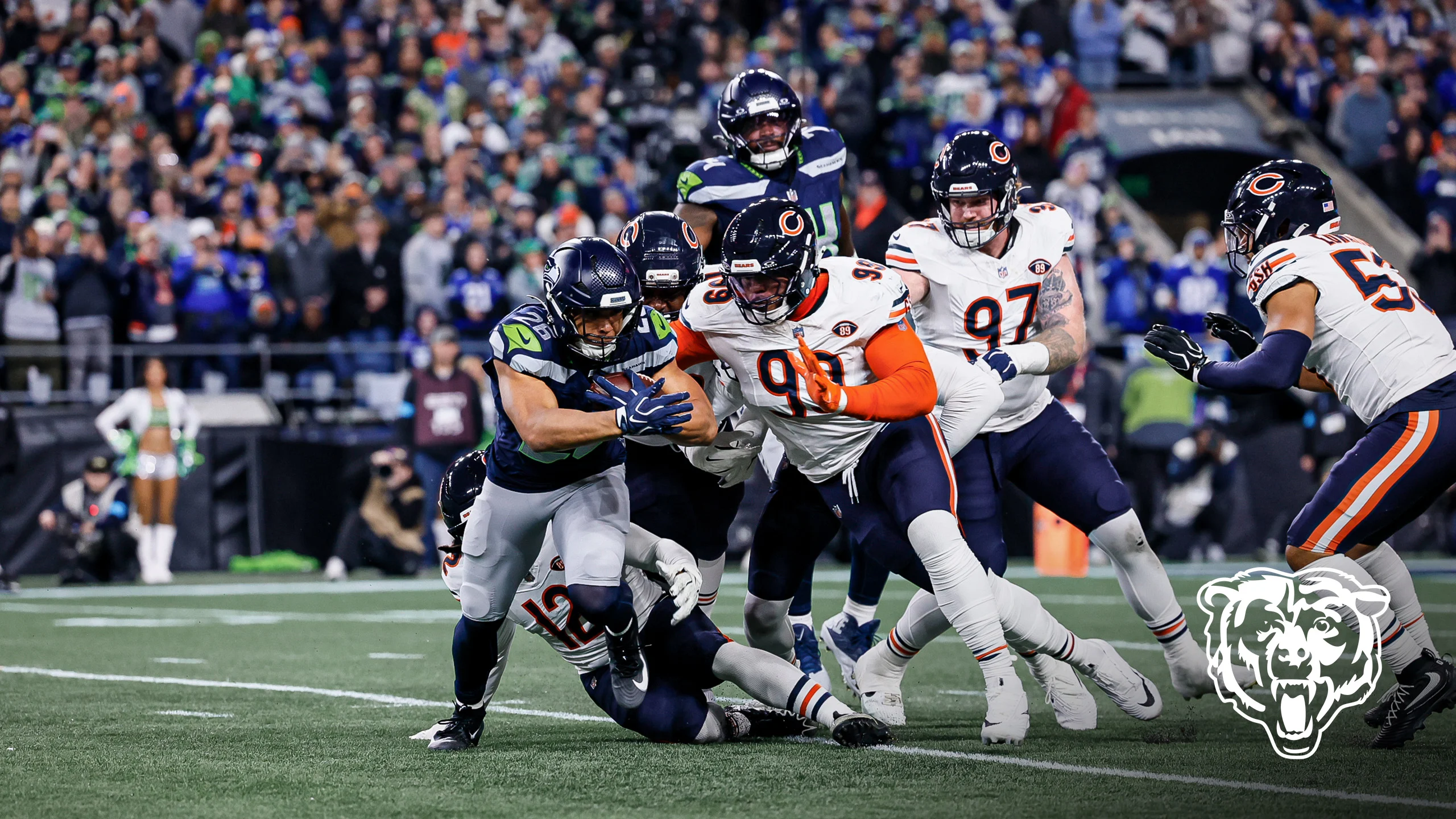
Chicago left Lumen Field with a 34-17 victory, a 6-2 record, and a complete performance against the reigning Super Bowl champion. Jeffery Simmons altered the line in his debut, Caleb Williams responded when the game tightened, and D’Andre Swift converted three times in the red zone.
The Bears paid a steep price for Simmons: first-round selections in 2027 and 2028, plus a fourth-round pick in 2027. In exchange, they received the defensive lineman and a fifth-round selection in 2028. The trade cannot be evaluated after a single game, but the first impression explained why Chicago decided to accelerate its competitive window.
Seattle converted just one of 11 third downs, accumulated 252 total yards, and saw Sam Darnold finish with 188 yards, two touchdowns, and an interception. Chicago produced 363 yards, scored on all four visits to the red zone, and set the best defensive numbers allowed by the Seahawks this season in points, total yards, passing yards, and first downs.
The final score suggests a comfortable victory. It wasn’t during the entire game: at the start of the fourth quarter, the difference was just three points.
Simmons needed a game to change the conversation
The defensive line didn’t need Simmons to fill the stat sheet to notice his presence. Nonetheless, the newly arrived player ended with six tackles, a sack, and a pass breakup. During the plays he was on the field, Seattle averaged just 3.0 yards per play.
That number doesn’t mean Simmons caused every failure of the opposing offense by himself. It does reflect the effect of adding a interior lineman who demands constant attention and changes the blocking distribution.
The context made his performance even more notable. Simmons arrived in Chicago on Thursday, stayed until near 10 p.m. studying the defensive plan, and returned early the next day. Four days later, he was playing in prime time. Ben Johnson handed him the game ball in the locker room and described his impact as «deep.»
His presence also freed up space for Montez Sweat, his former teammate in Mississippi State. Sweat recorded a sack and three quarterback hits; two other sacks were nullified by penalties. After the game, he explained that the attention given to Simmons allowed him to find individual matchups.
One game doesn’t guarantee that this formula will repeat. But for the first time this season, Chicago’s defensive line forced the opponent to decide where the damage could come from.
Caleb Williams responded without seeking a feat
Williams completed 24 of 34 passes for 247 yards, a touchdown, and no interceptions, with a passer rating of 101.0. Since his return from the hamstring injury, the Bears have scored 31, 30, and 34 points.
More important than the total production was his response when Seattle threatened to change the game.
The Seahawks closed within 20-17 at the start of the fourth quarter after DeMarcus Lawrence forced and recovered a fumble from Colston Loveland. On the next possession, Chicago seemed to have squandered a third down when Swift was stopped behind the line. The play, however, was nullified because the clock had expired before the snap.
On third and nine, Williams identified the pressure and placed the ball in the hands of Kalif Raymond with a lateral pass. The play was officially recorded as a 39-yard run and ended at the five-yard line. Swift scored immediately afterward to extend the lead to 27-17.
The sequence showcased the quarterback’s maturity: he didn’t attempt to manufacture a heroic play, delivered the ball on time, and allowed Raymond to exploit the space. Williams controlled the moment without exposing the possession.
He also distributed the ball with balance. Rome Odunze led the team with 87 yards on four receptions; Colston Loveland added 65 on seven, and Luther Burden III, 56 on seven catches and the touchdown of the opening drive.
Swift finished what the rest of the offense built
Swift’s rushing statistics require context: 69 yards on 27 carries, barely 2.6 per attempt. Seattle closed the spaces for much of the night and forced the running back to earn every yard. However, Chicago relied on him near the goal line, and Swift responded with three touchdowns, bringing his total to 10 on the ground this season.
It wasn’t a dominant performance between the 20-yard line. It was a decisive performance inside the red zone.
The offensive had set the tone from its first possession: 17 plays, 80 yards, and 8:32 of duration, culminating in a one-yard pass from Williams to Burden. Before the game, Seattle had accumulated 16 games without allowing a touchdown in the opening drive and 17 consecutive possessions without allowing a visit to the red zone.
The Bears ended four of four inside the 20-yard line. Against a defense that had made that zone its territory, Chicago didn’t leave any points available on the field.
Booker and Lynch closed all the exits
The defense and special teams protected the lead with two plays that shouldn’t be missed among the touchdowns.
Austin Booker blocked a 33-yard field goal attempt from Jason Myers when Seattle still could have cut the deficit. Later, Booker deflected a pass from Darnold and James Lynch intercepted it, returning it 16 yards to the six-yard line of the Seahawks. Swift converted the short field into the 34-17 final.
Lynch said after the game that he hadn’t intercepted a pass since high school. For Chicago, the play was more than a curiosity: it confirmed a night in which the three units contributed directly to the result.
Mike Macdonald, Seattle’s coach, acknowledged it without hesitation: the Bears had won the game cleanly and outplayed his team in all three phases.
The columnist’s note: after too long a wait
This victory sent a message to the rest of the NFL, but it meant something even more important for those of us who have followed the Bears for all these years: this team is ready to compete for everything.
We don’t say it only for the 6-2 record, for having beaten the champion at their stadium, or for the arrival of Jeffery Simmons. We say it for the way the players talk about Ben Johnson, for the conviction with which they defend the project, and for the confidence they show in each other when the game gets tough. In Chicago, it has been a long time since such a connection has been felt between the locker room, the coach, and the fans.
Since that 2006 team, we’ve lived through great defenses, hopeful seasons, and memorable victories. We’ve also confused too many times a winning streak with the building of something lasting. That’s why it’s hard to commit fully. The Bears fan has learned to celebrate while looking over their shoulder, waiting for the injury, the interception, or the incomprehensible decision that could end the illusion.
This time it feels different. When Seattle cut the lead to three points, Chicago didn’t collapse or need a miracle. The offense responded, the defense closed the game, and the special teams also did their part. The Bears didn’t survive the pressure: they played like a team that expected that moment and knew how to handle it.
That doesn’t mean everything is fixed. The 10 penalties for 85 yards, the fumble, and the two sacks of Sweat nullified by penalties could cost a win down the road. Nor can the trade for Simmons be declared a success after a single performance; two first-round picks require measuring that investment over several seasons and, mainly, in the playoffs.
But prudence shouldn’t prevent us from recognizing what we’re seeing. Simmons immediately raised the ceiling of the defense; Caleb understood what the game required; Swift finished the drives and the team responded as a unit. The Bears don’t seem like a group waiting to discover if they belong among the contenders. They’re starting to act like one.
For a fanbase that has waited two decades to feel something similar again, the victory in Seattle means much more than another result on the schedule. It doesn’t guarantee a championship, but it gives us the right to imagine it without feeling like we’re chasing a fantasy.
The next test will be at Soldier Field, in prime time, against Tampa Bay. For the first time in a long time, we won’t be arriving asking if the Bears can compete with the best. We’ll be arriving expecting them to prove it again.
Bear Down.