
Bears 3, Vikings 9: The Offense Stalls and Caleb Williams Suffers an Injury
Game recap of Bears vs. Vikings Week 2 of the 2026 NFL season: Minnesota won 9-3 at Soldier Field, Brian Flores stifled Chicago and Caleb Williams suffered a hamstring injury.
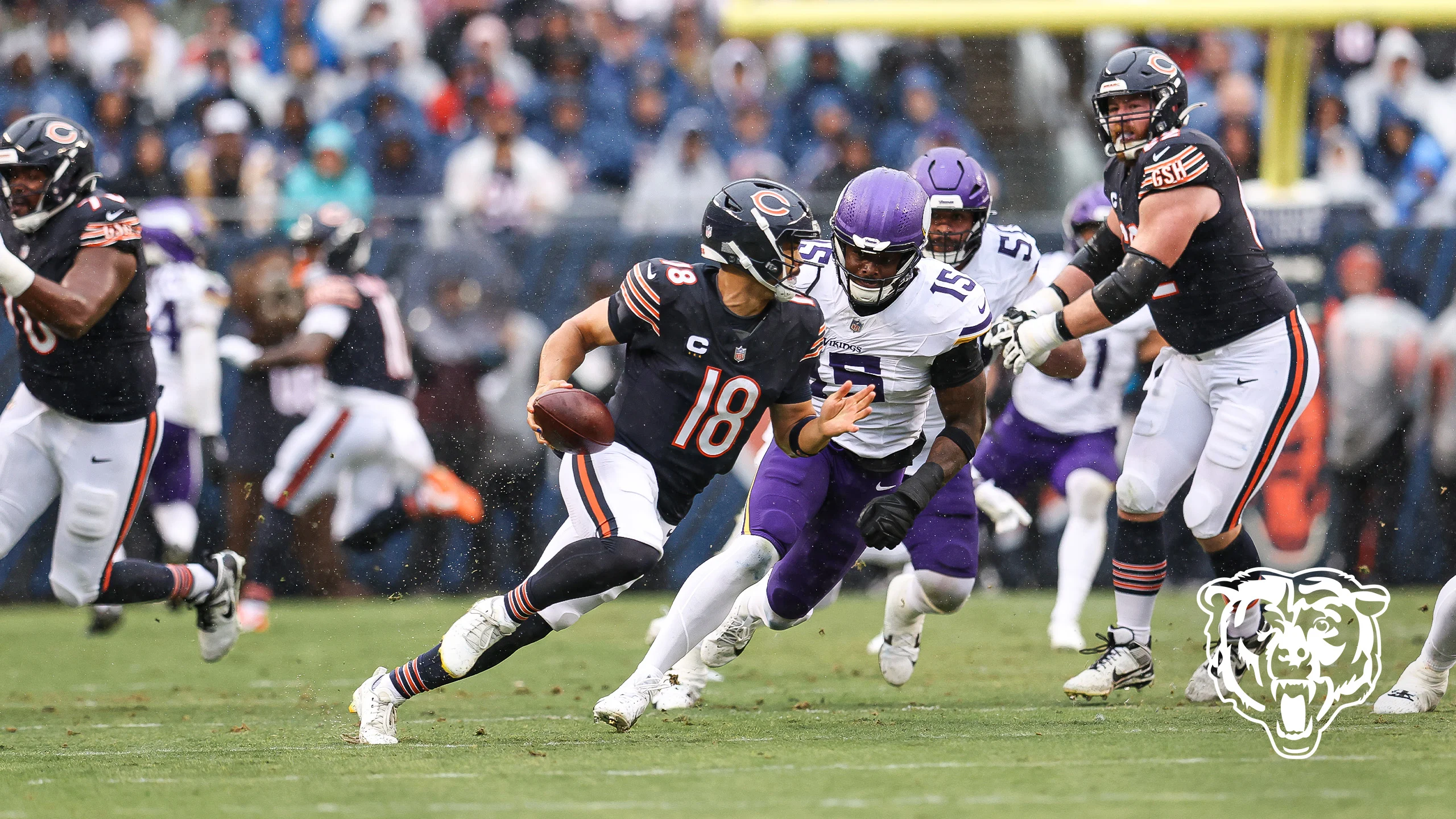
A week after scoring 59 points in Carolina, the Chicago Bears failed to cross the end zone once. Under the rain at Soldier Field, Minnesota won 9-3 in a gritty game dominated by the defenses and decided by the opportunities Chicago left behind. The loss put the Bears at 1-1; Caleb Williams’ injury pushed the score to the background.
Williams fell without contact while running to his left on a first and goal from the 6-yard line, mid-fourth quarter. He took his right leg, received help to reach the sideline and was then transported on a cart to the locker room. The team reported he suffered a hamstring injury. After the game, Ben Johnson said he didn’t yet know the severity and expected more information on Monday. That Caleb could walk after the game is encouraging, but it doesn’t allow anticipation of when he’ll return to play.
Flores changed the script
The contrast between the first two weeks of Chicago could hardly be greater. Against Carolina, the offense produced points almost at will; against Minnesota, Brian Flores dictated the game’s pace. His defense manipulated the reads before the snap, hit the quarterbacks and forced Chicago to play in increasingly unfavorable situations. The Vikings recorded four sacks, ten hits on the quarterback and two fumbles. Flores didn’t just stop big plays: he decided when the Bears could advance and how costly it would be.
Not everything can be explained by the opposing scheme. Chicago committed eight penalties for 58 yards, seven of them in the first half, and lost rhythm on drives that were already difficult due to the rain. Johnson acknowledged after the game: so many penalties against a good defense are like putting obstacles on yourself.
A line that didn’t hold the plan
The offensive line deserves direct criticism. Garrett Bradbury had a particularly bad afternoon against his former team: he was flagged for two false starts and two holding penalties in the first half, although one of these was nullified by penalties that were offset. The most costly sequence came when Chicago had reached the 30-yard line of Minnesota. An illegal move by Sam Roush, a hold by Bradbury, a pass intentionally thrown out of bounds by Williams and another false start by the center turned an opportunity for a score into a punt. Bradbury admitted afterward that those penalties were unforgivable.
On the left tackle, there was also no stable response. Braxton Jones started, but shared plays with Theo Benedet in a rotation that, according to Johnson, was planned. That it was a planned decision doesn’t change what was observed: Chicago continued looking for a solution on the blind side of Williams while Flores attacked the weaknesses in the protection. Ozzy Trapilo did not participate in the game.
The coaching staff turned to the tight ends to add blockers, but that support wasn’t enough to control the ends. The last sack summarizes the problem: Dallas Turner pushed Colston Loveland toward Bagent before bringing him down. Not all the pressures were the fault of a single lineman nor did the rain help anyone; nevertheless, the unit as a whole —line, support and adjustments— fell below what was required by this opponent. Minnesota didn’t let Chicago play at its pace.
Williams completed 15 of 26 passes for 138 yards and an interception before leaving. He also ran five times for 42 yards. It was a night of uncomfortable reads and intermittent gains, although it would be unfair to blame him alone for three points. The protection, the execution in key moments and the handoffs weighed as much as his decisions.
Three drives, no touchdowns
The offense reached the 1, 5 and 12-yard lines of Minnesota and didn’t score from any of those possessions. There it was the game. It also weighed the plays that never turned into touchdowns: the rookie Sam Roush dropped a pass with real touchdown potential in the fourth-quarter drive. It was a missed opportunity, not a guaranteed touchdown, but in a 9-3 game, each ball changes the story.
At the start of the second half, the Bears finally found consistent running and advanced to the 1-yard line. But Jalen Redmond stripped the ball from D’Andre Swift and Isaiah Rodgers recovered it for the Vikings. The best offensive drive of Chicago ended without reward.
Later came the play that changed the stadium’s mood: Williams was injured while seeking the touchdown with his legs. Tyson Bagent entered with Chicago down 6-3. The drive ended in a 23-yard field goal attempt that would have tied the game, but Isaiah Rodgers broke through the edge of the protection, where was Roush, and blocked the kick by Cairo Santos. It was another serious error by the rookie and the blocking unit; attributing it entirely to him would obscure a collective failure, but omitting his participation would soften what happened.
Minnesota extended the lead with a field goal by Will Reichard with less than a minute remaining. Bagent still moved the Bears to the 12-yard line, supported by three passes to Luther Burden III and one 21-yard pass to Rome Odunze. With one second left and fourth down, Dallas Turner sacked him and closed the game.
Chicago’s defense did respond
The result shouldn’t erase what the other half of the team did. After allowing 37 points to Carolina, the defense of Dennis Allen kept Minnesota out of the end zone, allowed 246 yards and limited the Vikings to three conversions in 13 third downs. Only one of their nine possessions reached the red zone.
Carson Wentz, the starter because Kyler Murray was still in the concussion protocol, completed 11 of 20 passes for 143 yards and didn’t lose the ball. He didn’t need a stellar game: his defense held the lead and the offense did enough to consume time and produce three field goals.
Johnson acknowledged the defensive response from Chicago and admitted the weight of the offensive errors and the blocked field goal. He also gave credit to the work of Flores: there are decisions that, viewed after the game, he would have liked to make differently.
“There are things that, looking back, I would have liked to do differently. That’s part of what makes facing Flores difficult. I think he did a great job.”
— Ben Johnson, in post-game statements; From Minnesota, Kevin O’Connell highlighted the defensive plan prepared with Flores during the week and the discipline with which his players executed it. It’s a more useful description than attributing everything to the bad weather: the Vikings played on the same wet field and were better in the moments that decided the outcome.
The note from the writer
A 1-1 record in September isn’t a verdict on the season. It is a warning. The Chicago offense has enough talent to fill a whiteboard, but on Sunday Flores forced them to play at Minnesota’s pace. The offensive line didn’t protect consistently, Bradbury accumulated avoidable errors and the help from the tight ends didn’t solve the problem. The penalties and missed opportunities near the goal line weren’t statistical details: they were the difference between winning and losing.
For now, the main question is Williams’ health. Until the team communicates a diagnosis and a timeline, any return schedule would be speculation. If he must miss time, Bagent will have the responsibility of leading the offense; if he returns soon, Johnson will have to show that this offense also knows how to win uncomfortable games.
The mud will dry. What must remain is the lesson: in the NFC North, it’s not always the team with more fireworks that wins, but the one that takes care of the ball and makes the most of its few opportunities.
Bear Down.