
Bears Forecast: Training Camp Log
Chicago Bears training camp 2026: we analyze Caleb Williams' progress, Darnell Wright's re-signing, injuries, and the battle for starting positions.
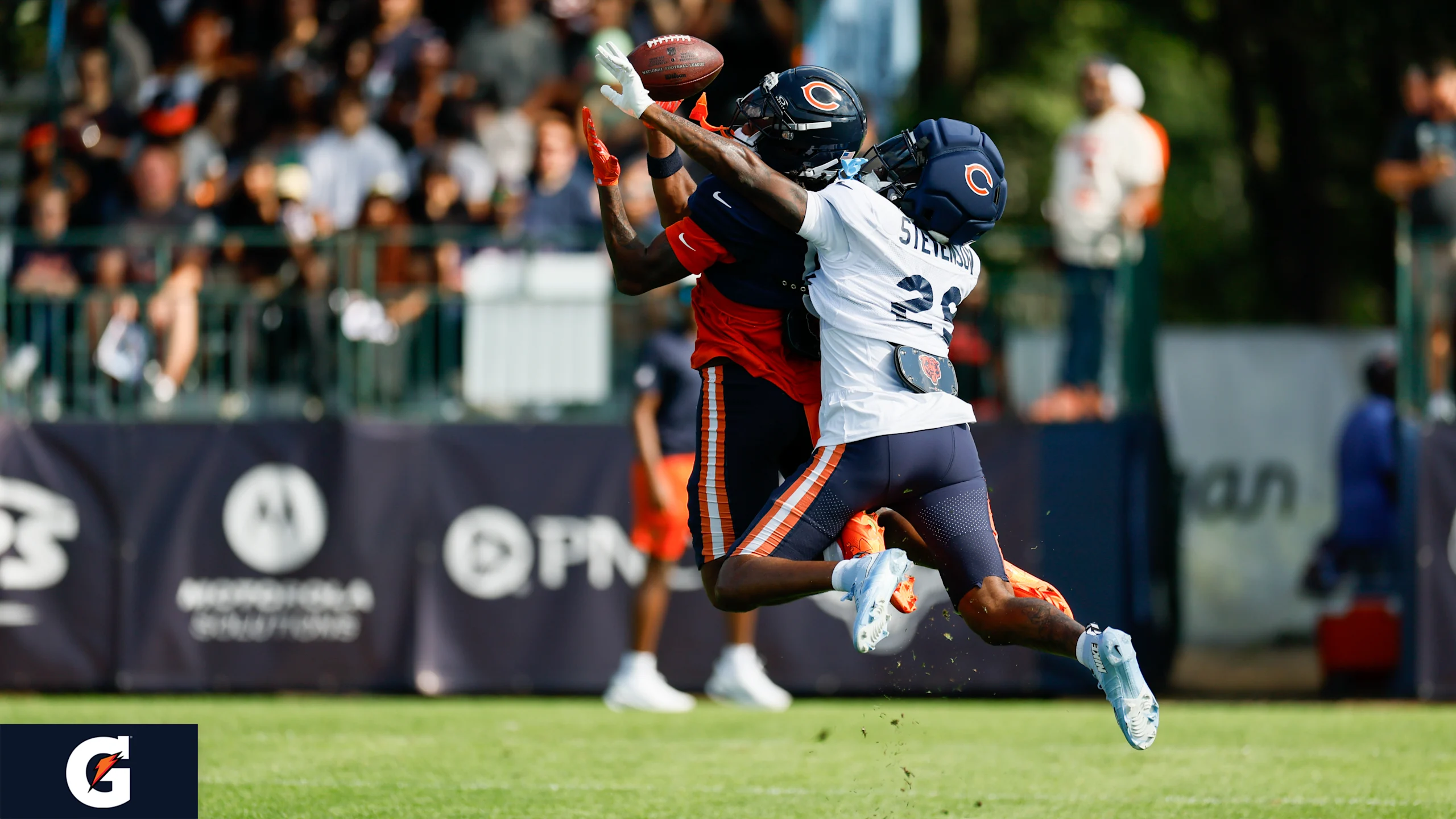
Summer football has a deceptive charm. Between the scorching sun of Lake Forest and the cheers from the temporary stands at Halas Hall, it’s easy to get lost in the daily routine of repetitions.
But, if we fine-tune our ears and look beyond the mechanical exercises, something different is in the air at this training camp: a mix of urgency and conviction. The Chicago Bears’ project seems to have left behind its status as an eternal promise and is now facing a much more demanding reality.
I. The message from the trenches: a matter of respect
There is no better thermometer for measuring the ambition of a franchise than the way it protects its foundations.
The news that shook Halas Hall this week didn’t arrive with a football in the air, but with a signature on paper: Darnell Wright agreed to a four-year, $116 million extension.
For those of us who have spent years watching the Bears improvising solutions on the offensive line, the news has special significance. Chicago isn’t trying to patch another hole; it’s betting on keeping one of the players who can carry the project through the next stage.
The contract is huge and the expectations will be at the same level. Wright will still have to justify that investment every Sunday, but the message from Ryan Poles is clear: if we want to protect Caleb Williams and build an offense capable of competing for something important, the work must start in the trenches.
Finally, the Bears seem to understand it.
II. Caleb Williams and the coldness of the surgeon
Let’s now talk about the one who really makes us hold our breath: the young man in number 18.
Those who have followed the practices with full protections describe a Caleb Williams who no longer seems to translate the playbook inside his head. Now he begins to interpret it in real time, with the fluidity of a quarterback who understands the system better and trusts what he sees.
During a two-minute simulated series, with the clock ticking and pressure closing in around him, Caleb completed his six passes for 53 yards. The drive ended with a three-yard touchdown pass to Luther Burden III at the end of the end zone.
The connection between Williams and Burden is acquiring dangerous implications for opposing secondaries. Burden is no longer that rookie trying to find his place within the offense: he enters his second year with greater responsibilities and the possibility of becoming one of the main weapons of the attack.
The work in the red zone also left encouraging signals. According to counts made during practice, Caleb completed nine of ten attempts and produced five touchdowns. More important than the numbers was the speed of his decisions: he received the ball, identified the coverage, and executed without letting the pressure disrupt the play.
It’s barely August and no practice can fully replicate the intensity or speed of an official game. Nonetheless, the signs are positive.
III. The price of impact: lights and shadows in the medical report
Practices with pads don’t forgive. If we want to observe true intensity, we must also accept the risk that comes with it.
The positive note was the return of T.J. Edwards, who, after dealing with calf issues, returned to the heart of the defense to help organize the front seven. His leadership was evident in the communication of assignments.
The bad news came from the secondary.
Coby Bryant could be out for eight to ten weeks after suffering a hyperextended knee, a bone contusion, and a minor fracture. Surgery is not expected, but his absence opens opportunities for other members of the secondary, including Cam Lewis.
The medical staff has also been cautious with important players like Braxton Jones, Montez Sweat, and Gervarrius Owens. At this time of year, any discomfort is evaluated with extreme care. The goal is not to win an August practice, but to have enough pieces ready by September.
IV. New blood: opportunities under observation
One of the names that deserves attention is that of first-round rookie safety Dillon Thieneman.
In the early practices, he has shown good instincts for reading the quarterback and speed to close gaps in deep coverage. These are encouraging signs, especially for a player just beginning to familiarize himself with Dennis Allen’s system.
Coby Bryant’s injury could accelerate his development and give him more repetitions than planned. That represents an opportunity, but also increases the pressure. Thieneman has the physical conditions to compete; now he will have to prove he can master the assignments, communicate with his teammates, and limit the mistakes typical of a rookie.
In quarterback pressure, Austin Booker has also left interesting moments. His energy and effort are evident, although standing out against the backup offense during training camp does not guarantee a significant role in the regular season. The next step will be to show the same presence facing better blockers and in situations closer to a real game.
The competition for the left tackle position continues open. Braxton Jones is trying to reclaim the starting role, while Kiran Amegadjie, Theo Benedet, and Jedrick Wills Jr. are using every repetition to make their case.
For now, there are good signs, but no definitive answers. In August, opportunities can be won; starting positions are confirmed when the games begin.
V. Final reflection: the taste of a new beginning
The week ends with the team preparing its community practice at Stevenson High School in Lincolnshire. Outside the field, a curious parallel story is unfolding: the production of Holiday Touchdown: A Bears Love Story, the Hallmark movie inspired by the franchise and filmed at various locations in Chicago.
But don’t be fooled: the real drama is being cooked on the grass of Halas Hall.
There is a different energy around this group. It’s a combination of hungry young players, established veterans, and rewarded players who refuse to become mere spectators.
Training camp is approaching, and for the first time in a long time, in Chicago we are not waiting for the future.
The future is already here.